
KARST Exhibition
- Kieran Collins

- Jun 12, 2021
- 3 min read
Updated: Jun 19, 2021
Title: Spring is here
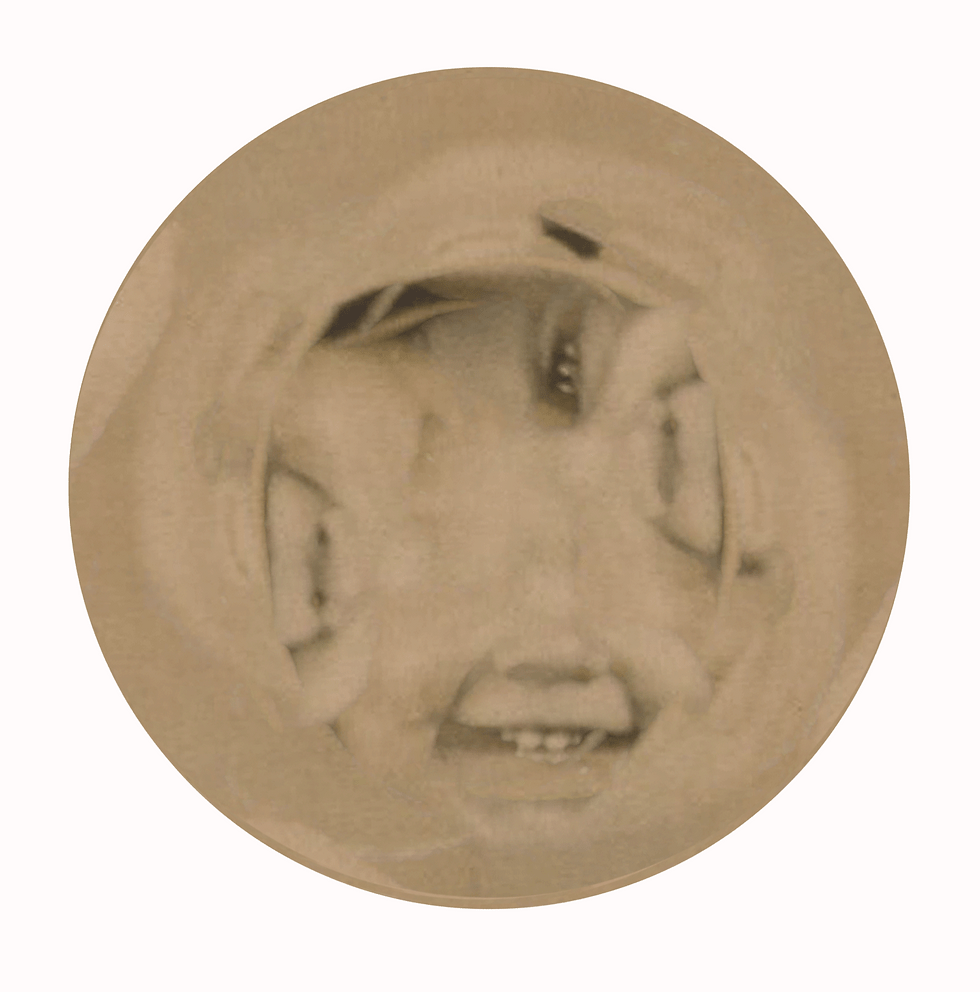
New Faming statement:
Spring Is Here
Interpreting photographs pose a series of challenges to different pasts, as memory interweaves with private fantasy and public history. Yet, unlike memory, photographs do not in themselves preserve meaning. They offer instant appearances. Meaning in the result of understanding a photograph, one must acknowledge a photograph takes place in time and must only be explained in time.
Led by repeated attempts of understanding the individual within the photograph abstraction emerges. Slippage between truth and narrative materialise as questions of identity. Bridging boarders, one must describe what can be seen to gain new understandings. Equilibriums between public and private are investigated where examinations around looking and seeing inform the output of the work itself.
Detachments of using traditional paper-based photography have led onto an experimental body of work, in turn; safeguarding the ‘original’ from becoming altered and potentially lost forever in time. Through digital technology manipulation outputs, the work can often be considered as uncanny. Departed is now the tactility of holding a person’s image that has run through so many hands before you. Instead, it can be seen dancing across the walls of a gallery or shared instantly online. The GIF alters the perception of what everyone has at home, the traditional family album, however. All images contain narratives, through this body of work an unravelling of narrative is discovered.
I am both your directions,
Existing more in the cold morning frost,
A murmur in my thoughts,
The kiss from the abyss,
Now finally
Spring is here.
Framing Statement Draft:
Throughout the current months, I have been concerned around the ideas of public and private. From looking and spending time with my collection I have understood that to understand their accurate identity I must look at the photographs with great detail and describe what I see. Over the past months I have created books that are my responses to looking, seeing and describing old found orphan photographs. Recently throughout this pandemic I have found out that my Nan Carol Ann was adopted which has made me reconnect to my own family album.
From interviewing Deborah Watson, a self-employed researcher and freelance archivist last year she gave me a lot of useful guides and tips into how I can identify the individual and to understand their narrative. Expanding on Watsons advice I began to read John Berger: understanding a photograph and his other book ways of seeing.
John Berger’s quote ‘Yet, unlike memory, photographs do not in themselves preserve meaning. They offer appearances – with all the credibility and gravity we normally lend to appearances- prised away from their meaning. Meaning in the result of understanding functions. “And functioning takes place in time and must be explained in time. Only that which narrates can make us understand.” Photographs preserve instant appearances. (Berger,2013, p.55) As I don’t understand nor know an accurate narrative and identity on Carol, I can only display the image and let it speak for itself. As the photographs of her are private the photographs of her are edited and made into GIF’s. Berger states in one of his books there are photographs for public and photographs which are private which are family photography.
From researching into artists such as Lindsay Seers whose artistic practice goes beyond simple storytelling to become a network in which conceptual investigation through making film installations. Her work is an act of observation which I have taken inspiration from.
The list:
· GIF
· Projection/Monitor
· Wall space.
· No sound
What I propose to show for this exhibition is a projection of one gif played on repeat. If I can’t get a projector, then I would like to display the piece on a monitor.
Second draft Framing Statement:


Comments