
Tate Modern London
- Kieran Collins

- Nov 13, 2021
- 2 min read
Objects in art:







Materials and Objects
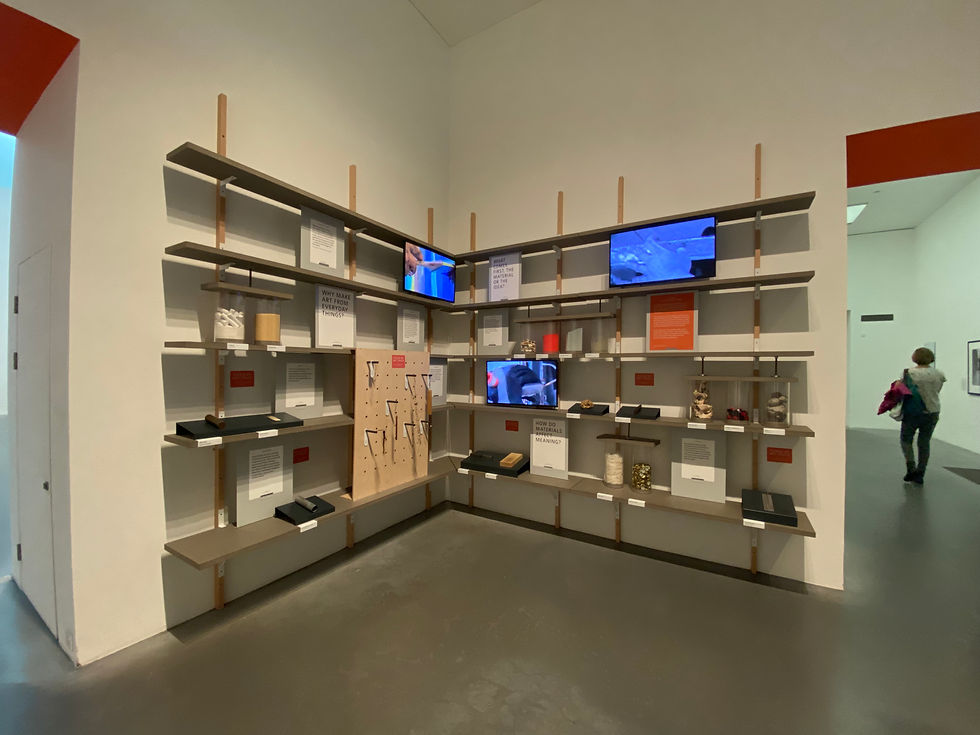
Materials and objects display, They look at some of the inventive ways in which artists around the world use diverse materials.
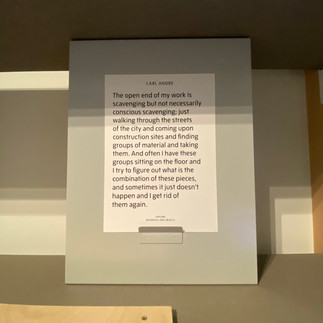
Increasingly over the last Hundred years, artists have challenged the idea that certain materials are unsuitable for art. some adapt craft skills, others make sculptures using everyday objects or repurpose familiar items.


Sarah Sze includes cheap, everyday objects, connecting the work to contemporary consumer culture. But Seamless also refers to art historical sources from the early twentieth century. Its structures and shapes relate to constructivism, abstract art that reflected the modern industrial world. And by using the colours red, blue and yellow, Sze recalls De Stijl. This modernist art movement promoted ‘pure’ abstraction using only straight lines and primary colours. Seamless is displayed together with Piet Mondrian’s Composition C (No.III) with Red, Yellow and Blue 1935 to highlight these references.
The Sculpture sweeps across the space in delicate curves, landing at two points on the floor. Titled Seamless, the work draws attention to the 'seams' of the museum building and the functional spaces behind its pristine 'white cube' galleries.
Mark Dion- Tate Thames Dig 1999



During the summer of 1999, U.S. artist Mark Dion and a team of volunteers drawn from local groups combed the foreshore of the Thames at low tide along two stretches of beach at Millbank and Bankside, near the Tate Gallery (now Tate Britain) and Bankside Power Station, which would become Tate Modern the following year.
Dion focused on a natural, historical constant. In this case, he turned to the banks of the River Thames, looking for fragments of individual and ephemeral histories. London's location, its growth and its fortunes can be attributed to the Thames. The two sites yielded a wide variety of artefacts and tokens of life as lined Millbank on the north shore of the Thames and Bankside on the south. Working over a number of days, Dion's team collected large quantities of items, including clay pipes, vividly decorated shards of delftware, oyster shells and plastic toys. The finds were then meticulously cleaned and classified in 'archaeologists' tents' on the Tate Gallery's lawn at Millbank during the summer of 1999.
Dion's practice incorporates aspects of archaeology, ecology and detection. His projects focus primarily on current issues surrounding the representation of nature and on the history of the natural sciences. Dion is simultaneously fascinated and repelled by the principles of taxonomy which have been used since the eighteenth century to classify and interpret the natural and man-made ephemera of the world.
YINKA SHONIBARE CBE- The British Library 2014


The British Library 2014 is an installation of 6,328 hardback books individually covered in colourful ‘Dutch wax print’ fabric and arranged on rows of shelving. Names are printed in gold leaf on the spines of 2,700 off the books. Visitors are also invited to submit their own stories using the tablets, and a selection of these responses is made available on the website. The books can be installed in purpose-built bookshelves to any configuration, or in existing bookshelves.


Comments